
A stainless steel sheet can have the right chemical composition and still behave differently during forming or in service because of its processing history. For buyers specifying 304 or 316L, the supplied condition deserves the same attention as the grade.
Solution annealing heats the material to a suitable temperature, holds it long enough for the required metallurgical changes, then cools it sufficiently quickly. In austenitic stainless steels, it can dissolve harmful precipitates and soften material hardened by cold working. The result depends on the entire thermal cycle, including what happens during cooling.
What changes during solution annealing?
Chromium-rich carbides can dissolve back into the matrix
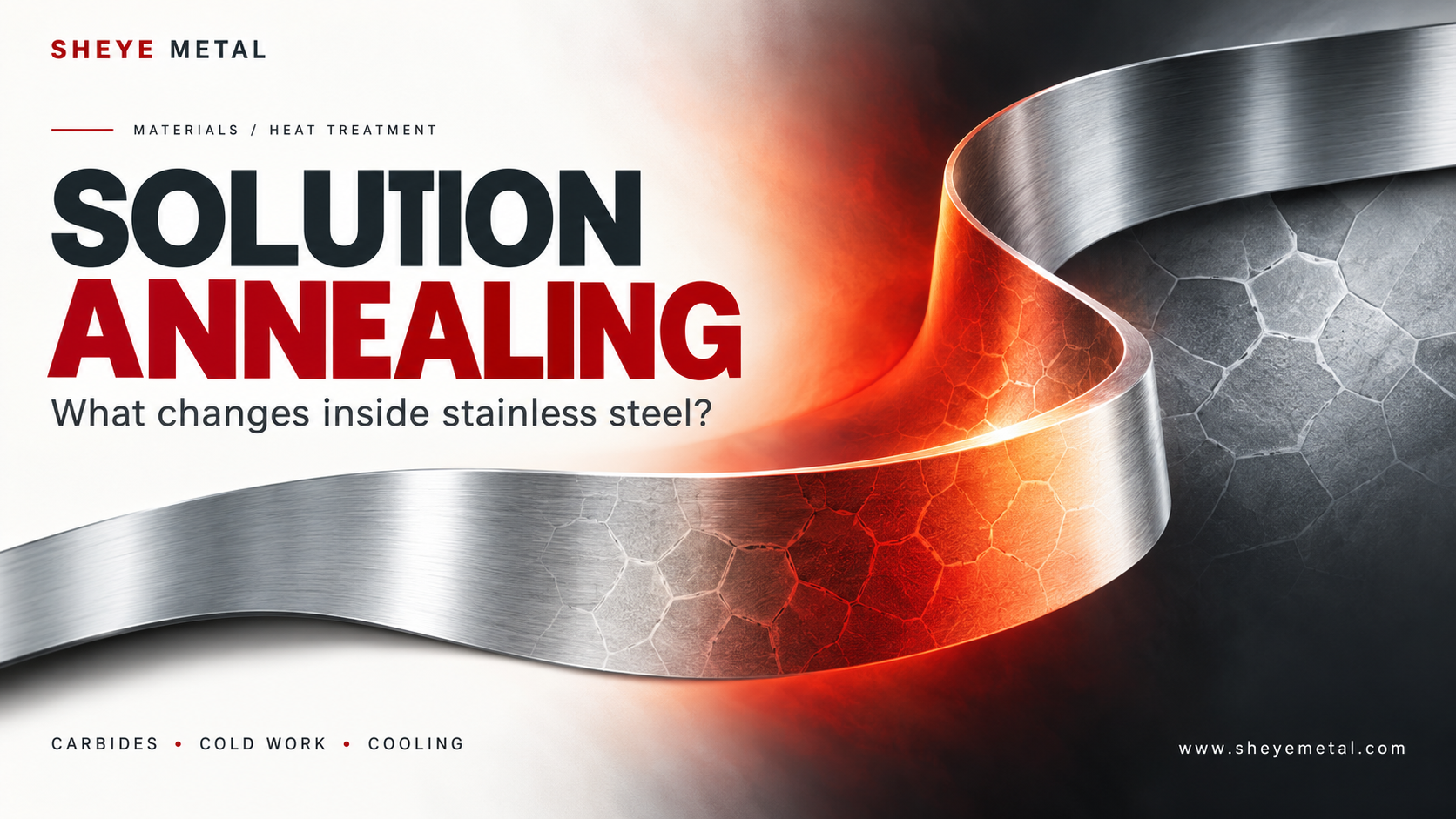
Under a suitable combination of temperature and time, chromium-rich carbides can precipitate at grain boundaries. Their formation can leave nearby regions depleted in chromium and more susceptible to intergranular corrosion. This condition is known as sensitization.
At a suitable solution-treatment temperature, these carbides can dissolve and chromium can redistribute into the surrounding matrix. Cooling sufficiently quickly limits renewed precipitation. The carbon content alone does not tell you whether a piece of 304 is sensitized: its thermal history also matters. Lower-carbon grades such as 304L reduce the tendency, but still need an appropriate manufacturing and fabrication route. BSSA explains the connection between precipitation, chromium depletion and sensitization.
Cold-worked material softens
Cold rolling, drawing and forming increase strength and hardness while consuming some of the material’s available ductility. During annealing, recovery and recrystallization can reduce the effects of cold work and produce new grains. This helps restore the softer condition needed for further forming.
A routine solution anneal does not remove every structural imperfection or fully eliminate casting segregation. Its effects depend on the starting structure, temperature and time. A separate homogenization treatment can involve different objectives and conditions.
Existing stresses relax, but cooling can introduce new ones
Heating can substantially reduce residual stresses from previous fabrication. Rapid, uneven cooling can then introduce fresh stresses or distortion, especially in components with varying section thickness. Solution annealing therefore does not guarantee a stress-free finished part. TWI discusses this trade-off for austenitic stainless steel weldments.
Why the cooling stage matters
The material must pass through temperatures at which harmful precipitates can form. For sensitization, BSSA describes an approximate range of 370 to 815°C. This is not an instant failure zone: composition and time at temperature affect the response. Slow cooling can undo some of the benefit of dissolving carbides during heating.
The required cooling method depends on the grade, product and section size. Water quenching is commonly used where rapid cooling through the section is needed. Air cooling can be suitable for some thinner products when it provides an adequate cooling rate. A furnace temperature reading or a clean-looking surface cannot establish that the centre of a thick component followed the required thermal cycle.
For example, Alleima recommends rapid cooling in air or water after solution annealing its SAF 2205 seamless tube, while its Sanmac 2205 billet guidance specifies water cooling. Product-specific instructions matter even within the same stainless steel family.
Solution annealing, annealing and normalizing
| Term | Meaning for the buyer |
|---|---|
| Solution annealing | A treatment used to dissolve specified phases into the matrix, followed by cooling that retains the required condition. It is used for austenitic and duplex stainless steels, among other alloy systems. |
| Annealing | A broad family of heat treatments. For austenitic stainless steel, this often means solution annealing. The word alone does not specify a slow cooling cycle or a lower-temperature treatment. |
| Stress relieving | A treatment intended to reduce residual stress. Its temperature and metallurgical effects require separate consideration; it is not automatically equivalent to a full solution anneal. |
| Normalizing | A term primarily used for steels treated through phase transformations, such as many carbon and low-alloy steels. It is not the usual treatment designation for 304 or 316L. |
When an order calls for “annealed” stainless steel, identify the applicable product specification and delivery condition. An intermediate anneal describes its position between processing stages; it does not, by itself, define the thermal cycle.
Why different grades need different treatment conditions
A temperature range is meaningful only with its material and product scope. Alleima’s 3R12 seamless tube data sheet for 304/304L gives 1000 to 1100°C for solution annealing, followed by rapid cooling in air or water. Its SAF 2205 seamless tube guidance gives 1020 to 1100°C. These are manufacturer recommendations for named products, not interchangeable recipes for every sheet, forging or welded assembly.
| Grade family | What needs attention |
|---|---|
| 304 / 304L | Carbide dissolution, cold-worked condition and cooling rate. Low carbon reduces sensitization risk but does not remove the need to control the process. |
| 316 / 316L | Use guidance for the molybdenum-bearing grade and the actual product. A 304 procedure should not be transferred solely because both grades are austenitic. |
| 321 / 347 | Titanium or niobium stabilization changes the carbide chemistry. Solution annealing and stabilization treatment serve different purposes; the intended service and specification determine what is required. See ATI’s guidance for stabilized grades. |
| 2205 duplex | Control the ferrite-austenite balance as well as harmful precipitation. Temperature and the subsequent cooling path must be considered together. |
| 904L | Use the producer’s guidance for this highly alloyed grade. Dissolving harmful precipitates requires appropriate temperature and time, with sufficient cooling afterwards. |
The IMOA fabrication guide, second edition (2020), section 11 explains why annealing temperature, holding time, atmosphere and cooling must be selected together. Its guidance also distinguishes minimum temperatures from complete operating ranges.
What poor heat treatment can look like
Unwanted precipitation can increase susceptibility to corrosion. Material that retains too much cold work may have excessive hardness or insufficient ductility for the next forming operation. Excessive temperature or time can promote grain growth, scaling and distortion. Grain size and tensile properties should be judged against the agreed product requirements, rather than a single universal acceptance value.
Where required, an appropriate ASTM A262 practice can assess susceptibility to intergranular attack in austenitic stainless steels. The selected practice, specimen condition and acceptance criteria need to be specified. An A262 result does not establish resistance to every form of corrosion.
Magnetism is also easy to misread. Annealed wrought 304 normally has a low magnetic response, while cold work can create magnetic martensite. Weld metal or cast material can contain ferrite. A magnet alone cannot establish the grade or certify the heat treatment, and some products are intentionally supplied in a cold-worked condition. ASSDA explains these magnetic effects.
Holding time and atmosphere deserve attention
Holding time needs to account for the material reaching temperature through its section and for the required metallurgical changes. A rule such as “one hour per 25mm” cannot define every stainless steel annealing cycle. Thin strip on a continuous line and a heavy forging in a batch furnace have very different heating conditions.
Air heating normally produces scale that needs suitable removal. Bright annealing controls the atmosphere to limit oxidation. Hydrogen-based or cracked-ammonia atmospheres can be used, but gas composition, dryness and furnace control determine the result. A bright surface is not, on its own, proof of a satisfactory internal structure.
Specify the condition along with the grade
For a stainless steel purchase, state the grade, product standard and required delivery condition, then explain the subsequent forming, welding or service requirements. Where relevant, agree the mechanical properties, grain-size requirements, corrosion-test method and sampling location before production.
When sourcing 304 stainless steel sheet or another grade from Sheye Metal, include these details with the dimensions, quantity and surface finish. Our quality and documentation information describes how material identity and inspection records support an order. Discuss your material requirements so the supply condition and required documentation can be reviewed together.
PRODUCTS