Ask about the difference between 304 and 304L stainless steel, and the answer is usually simple: 304L has less carbon. That is correct, but it does not tell a buyer everything needed to specify, weld or accept the material. The applicable product standard, mechanical properties and mill test certificate matter too.
This guide compares the Chinese pressure-equipment grades S30408 and S30403 under GB/T 713.7—2023, then explains the practical implications for stainless steel buyers.
304 vs 304L: start with the correct standard
GB/T 713.7—2023 covers stainless and heat-resisting steel plate, sheet and strip for pressure equipment. Within this standard, 304 corresponds to 06Cr19Ni10 / S30408, and 304L to 022Cr19Ni10 / S30403. The “L” stands for low carbon.
The standard was published on 6 August 2023 and took effect on 1 March 2024, replacing GB/T 24511—2017. Official standard record.
Chinese, ASTM, ASME and EN requirements are not automatically interchangeable. A grade name is only part of a specification; the product standard, edition, delivery condition and applicable dimensions also matter.
| Requirement | 304 / S30408 | 304L / S30403 |
|---|---|---|
| Carbon, maximum | 0.08% | 0.030% |
| Chromium | 18.00–20.00% | 18.00–20.00% |
| Nickel | 8.00–10.50% | 8.00–12.00% |
These selected elements are not the complete chemical specification. The wider nickel range is another distinction under this particular standard.
Why lower carbon matters after welding
Chromium helps stainless steel maintain the passive surface film that provides its corrosion resistance. With sufficient time in a sensitising temperature range, approximately 450–850°C, chromium-rich carbides can precipitate at grain boundaries. This can leave adjacent regions depleted in chromium and more vulnerable to intergranular corrosion in a susceptible environment. Metallurgical reference.
Composition and time at temperature both matter: merely passing through that range does not inevitably cause sensitisation.
Reducing carbon limits carbide formation. This gives 304L an advantage in welded equipment that will not receive a complete solution treatment after fabrication, particularly where repeated welding cycles or corrosion-sensitive service make the heat-affected zone a concern.
However, lower sensitisation risk does not mean immunity to corrosion. Both 304 and 304L can suffer pitting, crevice corrosion or stress corrosion cracking under unsuitable service conditions. Low carbon alone does not give 304L the chloride-corrosion resistance associated with molybdenum-alloyed grades such as 316L. Chloride level, temperature, deposits and equipment design still matter. Corrosion guidance.
The nickel ranges differ, but every heat is different
Under GB/T 713.7—2023, the upper nickel limit is higher for S30403 than for S30408. This is a permitted composition range, not a promise that every heat of 304L contains more nickel than every heat of 304.
Nickel stabilises austenite, and carbon also contributes to its stability. Steelmakers balance the complete composition to obtain the required properties. This is useful metallurgical background; nickel limits alone do not establish why a particular heat was formulated as it was.
Read the actual heat analysis on the mill test certificate, or MTC. A higher permitted maximum is not a higher measured content, and nickel content alone does not establish overall material quality.
Strength requirements are part of the comparison
Carbon contributes to strengthening, so reducing it can affect strength. GB/T 713.7—2023 also specifies different mechanical-property requirements for S30408 and S30403. Those requirements must be read with the applicable thickness, delivery condition and test provisions.
| Requirement | 304 / S30408 | 304L / S30403 |
|---|---|---|
| 0.2% proof strength, Rp0.2 (MPa) | ≥230 | ≥220 |
| 1.0% proof strength, Rp1.0 (MPa)* | ≥260 | ≥250 |
| Tensile strength, Rm (MPa) | 520–720 | 500–700 |
| Elongation after fracture, A (%)** | ≥45 | ≥45 |
* Rp1.0 is tested only when the purchaser requests it and specifies it in the contract. ** For thickness ≤3.00 mm, Table 16 specifies A50 mm using specimen P5 in GB/T 228.1. The applicable product scope, sampling and test conditions remain part of the specification. This is a selected tensile comparison, not the complete acceptance requirements or design allowable stresses. Standard reference.
A specified minimum is an acceptance threshold, not the result for every plate. Actual properties can exceed it, and individual heats of 304L may meet 304 strength requirements. Compare certificate results with the complete requirements for the ordered product.
This distinction matters when a design uses material strength to establish allowable stress or required thickness. “Lower carbon” cannot, by itself, justify accepting a different grade.
304L is often preferred for weldments; 304 is also weldable
304 is a weldable austenitic stainless steel. The practical advantage of 304L is primarily its reduced susceptibility to sensitisation after welding, rather than an inherently more attractive weld bead or a guarantee of defect-free fabrication.
304L is often worth considering for thick sections, multiple-pass welds, closely spaced welds, large vessels that cannot be solution treated as a whole, and equipment with specified intergranular-corrosion requirements. Chemical, food, pharmaceutical and heat-transfer equipment may present such conditions, depending on the actual process.
304 can remain suitable where the design permits it and the welding procedure, subsequent treatment and service environment are appropriate. Low carbon also does not replace sound fabrication: heat input, filler selection, joint design and removal of harmful weld oxides or contamination still need attention.
Can 304L replace 304 on a purchase order?
Not automatically. For some non-pressure applications, an agreed substitution may be practical. For pressure equipment, the specified grade is tied to more than chemistry: strength, design data, fabrication procedures, testing and traceability can all be relevant.
If the drawing specifies S30408 but the certificate identifies only S30403, the discrepancy needs to be resolved through the applicable material-substitution procedure. The responsible design, fabrication and inspection parties should confirm acceptance under the governing requirements.
A supplier can clarify available material and certification; lower carbon does not authorise it to redefine the designer’s requirement.
What does 304/304L dual certification actually mean?
A material can potentially satisfy the requirements of both grades. However, low carbon plus sufficiently high strength is only part of the assessment. The complete chemistry, mechanical properties and other applicable requirements must satisfy both specifications.
For example, a heat that fits the wider S30403 nickel range could still exceed the S30408 nickel limit. That is one reason “low-carbon 304” and “formally dual-certified 304/304L” should not be treated as identical descriptions.
Look for explicit certification to both grades on the MTC, together with the relevant standards and matching material identification. Do not add a second grade designation to a certificate on the strength of a few favourable test results. A handheld XRF alloy check is useful for screening alloying elements, but conventional handheld XRF does not measure carbon and cannot establish the low-carbon grade on its own. XRF measurement limitations.
Two actual mill certificates: 304 and 304L in 3 mm coil
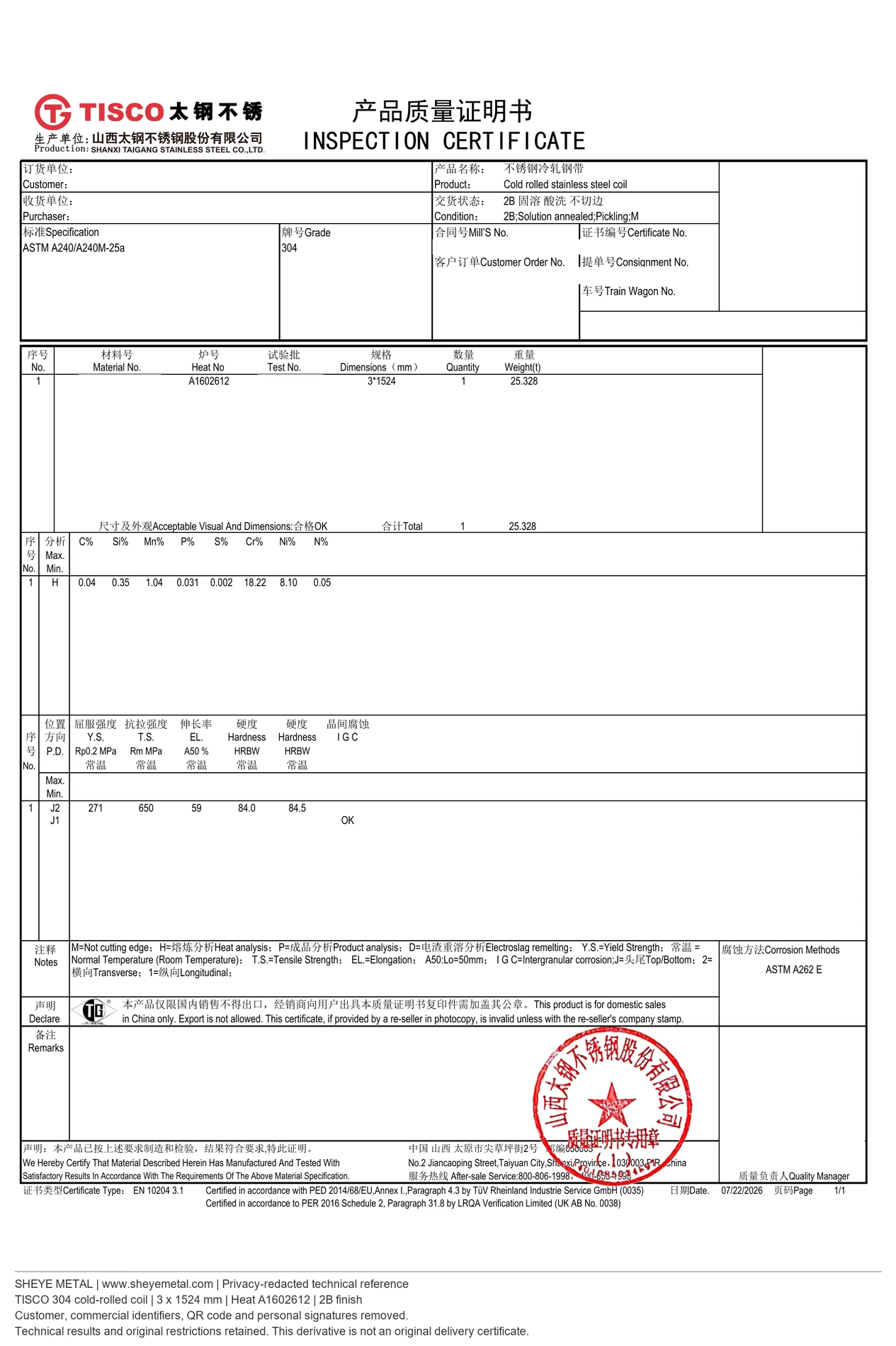
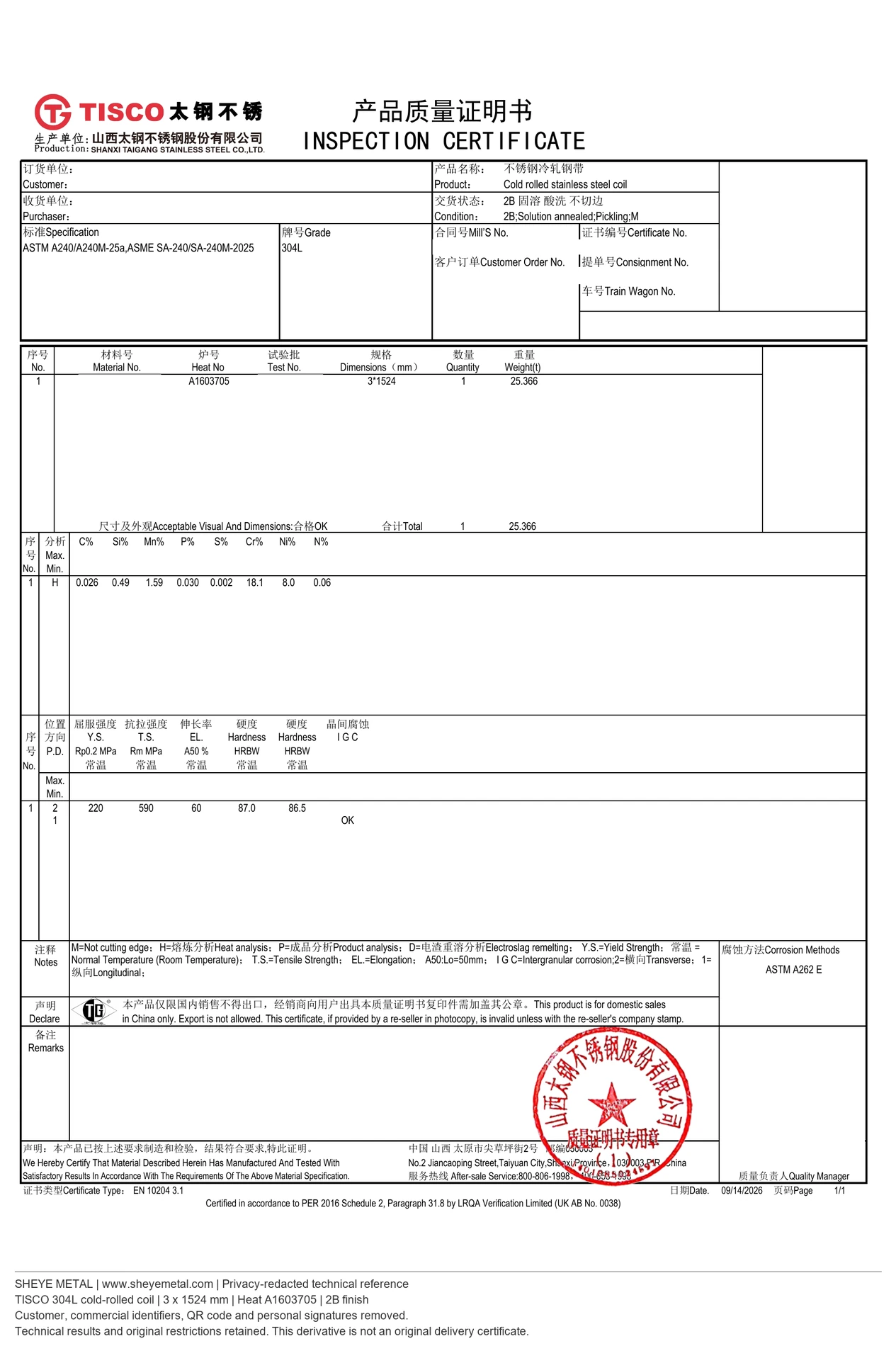
Two TISCO mill certificates supplied for this comparison show why actual heat data matter. Both describe 3 × 1524 mm cold-rolled coil with a 2B finish, supplied solution annealed and pickled with uncut edges. These are parent coils, not certificates for finished cut-to-length sheets.
The 304 certificate identifies heat A1602612 to ASTM A240/A240M-25a. The 304L certificate identifies heat A1603705 to ASTM A240/A240M-25a and ASME SA-240/SA-240M-2025. They are separate grade certifications, not a 304/304L dual certificate, and neither should be described as certification to GB/T 713.7—2023.
| Element | 304 · A1602612 | 304L · A1603705 |
|---|---|---|
| Carbon (C) | 0.04 | 0.026 |
| Silicon (Si) | 0.35 | 0.49 |
| Manganese (Mn) | 1.04 | 1.59 |
| Phosphorus (P) | 0.031 | 0.030 |
| Sulfur (S) | 0.002 | 0.002 |
| Chromium (Cr) | 18.22 | 18.1 |
| Nickel (Ni) | 8.10 | 8.0 |
| Nitrogen (N) | 0.05 | 0.06 |
| Reported item | 304 · A1602612 | 304L · A1603705 |
|---|---|---|
| 0.2% proof strength, Rp0.2 (MPa) | 271 | 220 |
| Tensile strength, Rm (MPa) | 650 | 590 |
| Elongation, A50 (%) | 59 | 60 |
| Rockwell hardness, HRBW (two readings) | 84.0 / 84.5 | 87.0 / 86.5 |
| ASTM A262, Practice E | OK | OK |
Neither certificate reports Rp1.0. The elongation values are specifically reported as A50; they should not be compared directly with a differently defined elongation requirement without checking the specimen and gauge-length provisions.
In these two heats, 304L has lower carbon and slightly lower nickel. Its reported proof and tensile strengths are lower, while its two hardness readings are higher. The results illustrate actual variation between heats; they do not establish a universal ranking of 304 and 304L or allow hardness to replace tensile testing.
Both certificates record the specified intergranular-corrosion test as “OK”. The 304 result does not establish resistance after every subsequent welding or heat-treatment cycle, and it does not remove the reason to consider 304L where sensitisation is a concern.
Choosing 304 or 304L for your next order
Start with the service conditions and design specification. Where sensitisation after welding is a concern, 304L commonly offers a useful advantage. Where strength requirements, fabrication and corrosion exposure are already addressed by the design, 304 may be entirely appropriate. Neither grade is a universal answer for severe chloride service.
Before requesting a quotation, specify the product form, dimensions, surface finish, standard and edition, grade or required dual certification, and any additional inspection or corrosion tests. This gives the supplier a clear basis for matching material to the order.
Sheye Metal supplies 304 stainless steel plate, 304L stainless steel plate and 304/304L stainless steel sheet, with processing and inspection support. Our quality and inspection approach connects the ordered specification, material identification and supporting documents. Send your requirements to sales@sheyemetal.com so we can discuss suitable supply options and available certification.
Technical references: GB/T 713.7—2023, Steel plate, sheet and strip for pressure equipments—Part 7: Stainless steel and heat resisting steel; Outokumpu Core range: 304 and 304L. Numerical comparisons on this page apply to the stated standard and product conditions; use the governing specification for the actual order.
PRODUCTS
Related products
304 Stainless Steel Plate
304 stainless steel plate for specification-led procurement, with dimensions, inspection and export packing reviewed by order.
View specifications304L Stainless Steel Plate
Sheye Metal supplies 304L stainless steel plate in coil-cut and quarto forms, with NO.1, 1D or NO.1/1D mill surfaces. Request your preferred mill source, custom length and width, and heat-linked certificates with…
View specifications