A furnace fabricator comparing 310S vs 309S vs 253 MA needs to know how the material will behave under heat, load and repeated shutdowns. A temperature quoted in a brochure answers only part of that question. The atmosphere around the metal, the stress in the component and the required service life also affect the choice.
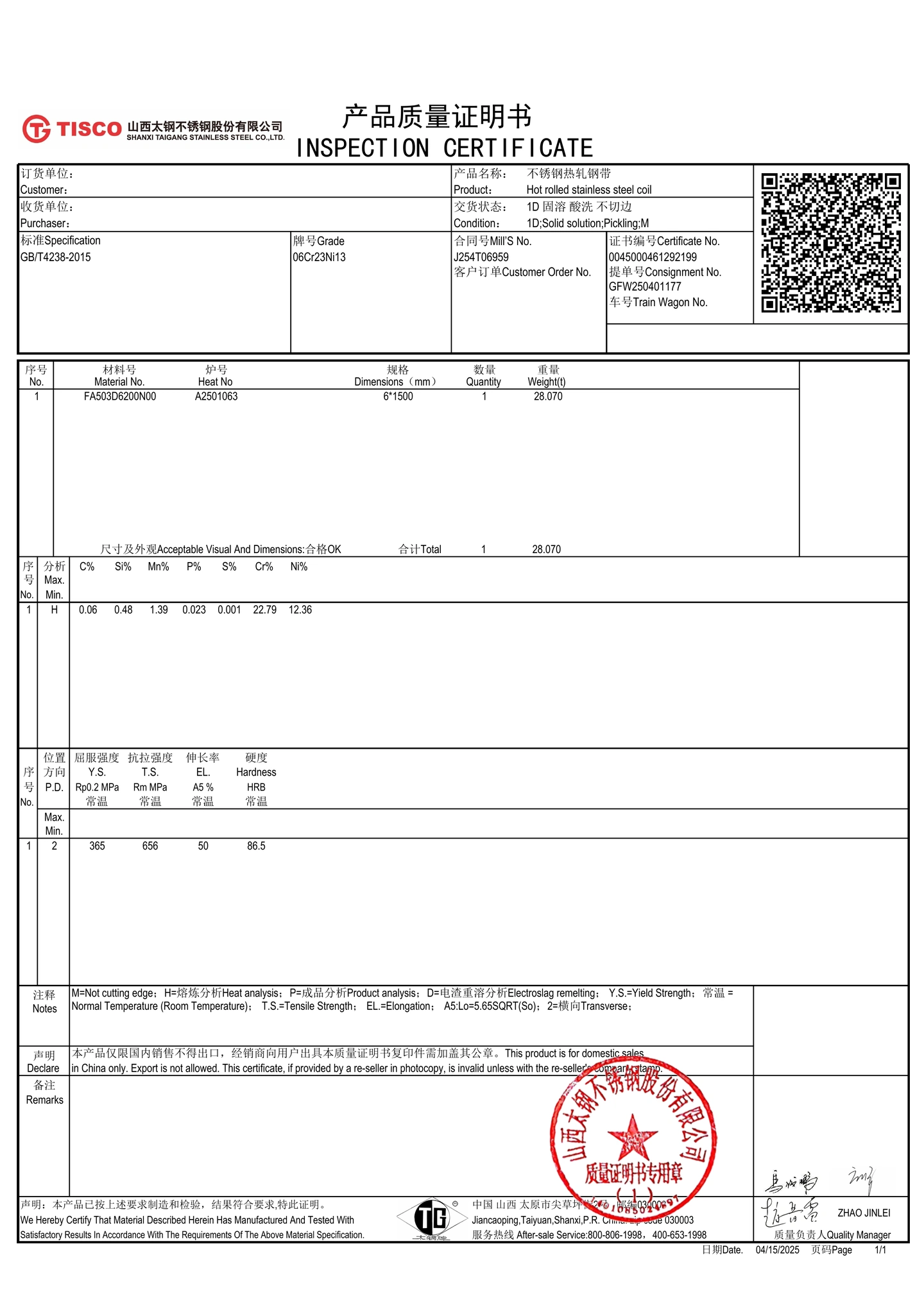
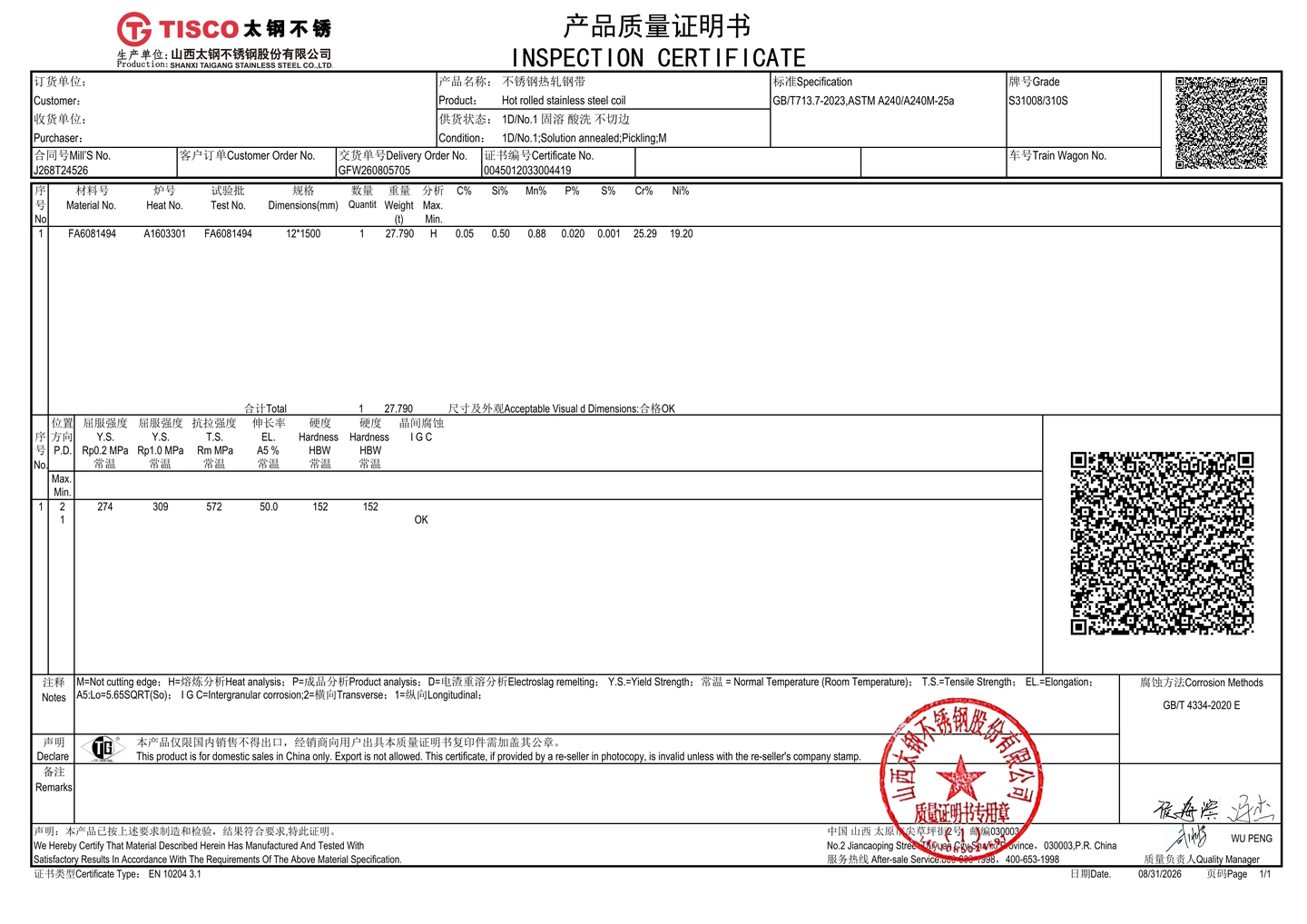
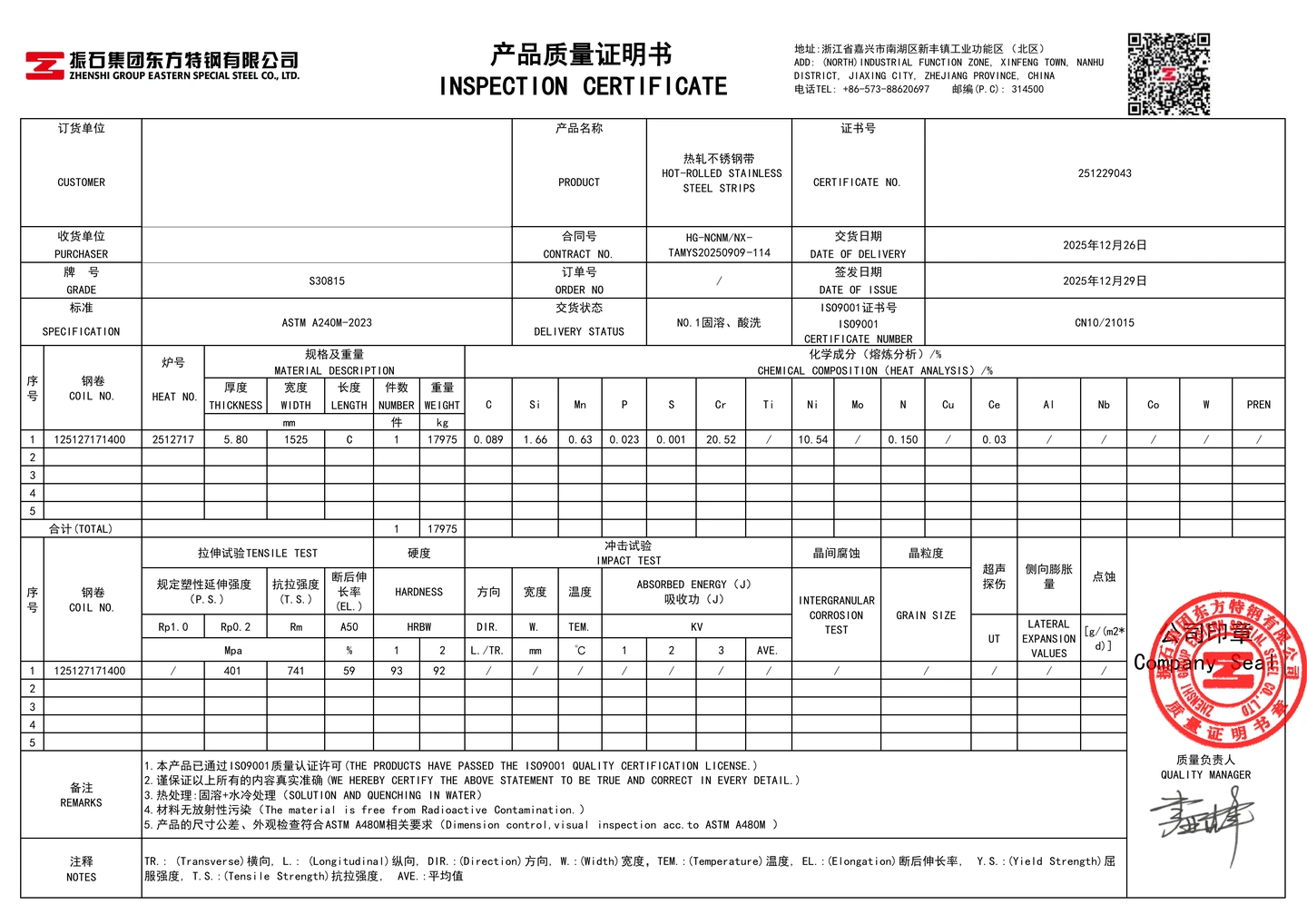
This guide uses three supplied mill test certificates to compare actual chemistry and mechanical results: a TISCO 06Cr23Ni13 coil supplied as the 309S comparison sample, a TISCO S31008/310S coil, and a Zhenshi Group Eastern Special Steel S30815 coil. The certificates document different production heats and thicknesses. They provide useful purchasing evidence, but none reports high-temperature creep or service-life test results.
309S, 310S and 253 MA: a practical starting point
| Grade reference | Guidance temperature in air, °C |
|---|---|
| Therma 309S | 1000 |
| Therma 310S | 1050 |
| Therma 253 MA | 1150 |
The temperatures above are Outokumpu guidance values for use in air, referenced to EN 10095. They are not universal operating limits, allowable stresses or guarantees for the three certified coils. Loaded components can require a lower design temperature. See the Outokumpu Therma datasheet for the stated conditions.
Alleima identifies 253 MA as a trademark owned by Outokumpu, with UNS designation S30815. The third certificate here identifies S30815 from Eastern Special Steel; it does not establish that the coil is branded Outokumpu 253 MA material. Specify the grade, manufacturer and applicable product standard separately when ordering.
What the three mill certificates actually identify
| Certificate field | 309S comparison sample | 310S sample | S30815 sample |
|---|---|---|---|
| Manufacturer | TISCO | TISCO | Zhenshi Group Eastern Special Steel |
| Recorded grade | 06Cr23Ni13 | S31008 / 310S | S30815 |
| Thickness × width, mm | 6.0 × 1500 | 12.0 × 1500 | 5.80 × 1525 |
| Heat number | A2501063 | A1603301 | 2512717 |
| Material / coil identifier | FA503D6200N00 | FA6081494 | 125127171400 |
| Certificate number | 0045000461292199 | 0045012033004419 | 251229043 |
| Certificate date | 2025-04-15 | 2026-08-31 | 2025-12-29 |
| Recorded standard(s) | GB/T 4238-2015 | GB/T 713.7-2023; ASTM A240/A240M-25a |
ASTM A240M-2023 |
The document supplied under the filename “S30815 6MM” records a thickness of 5.80 mm. That value is retained here. Likewise, the 309S comparison column retains the certificate’s actual designation, 06Cr23Ni13, rather than replacing it with an assumed ASTM certification.
When material is cut from a coil into plates, the finished plate identification should remain traceable to the source heat and coil. A coil certificate alone does not record the dimensions or inspection results of every subsequently cut plate.
Chemical composition: measured heat results
| Element | 06Cr23Ni13 / 309S sample | S31008 / 310S | S30815 |
|---|---|---|---|
| Carbon, C | 0.06 | 0.05 | 0.089 |
| Silicon, Si | 0.48 | 0.50 | 1.66 |
| Manganese, Mn | 1.39 | 0.88 | 0.63 |
| Phosphorus, P | 0.023 | 0.020 | 0.023 |
| Sulfur, S | 0.001 | 0.001 | 0.001 |
| Chromium, Cr | 22.79 | 25.29 | 20.52 |
| Nickel, Ni | 12.36 | 19.20 | 10.54 |
| Nitrogen, N | — | — | 0.150 |
| Cerium, Ce | — | — | 0.03 |
The 310S heat has the highest measured chromium and nickel contents in this set: 25.29% Cr and 19.20% Ni. The S30815 heat contains less nickel, at 10.54%, together with 1.66% Si, 0.150% N and 0.03% Ce. These results illustrate two different alloying approaches; nickel content alone cannot rank high-temperature performance.
Alleima describes nitrogen alloying for creep strength and silicon and rare-earth additions for oxidation performance. The supplied S30815 analysis documents those elements, but does not measure oxide-scale adhesion or creep life. Alleima’s 253 MA tube and pipe datasheet provides background on the alloy system, rather than test evidence for this coil.
A dash in the table is a reporting gap, not a zero concentration. The absence of nitrogen or cerium entries on the two TISCO documents should not be turned into a claim that the elements are entirely absent.
Mechanical properties: compare the test method as well as the number
| Test item | 06Cr23Ni13 / 309S sample | S31008 / 310S | S30815 |
|---|---|---|---|
| 0.2% proof strength, Rp0.2, MPa | 365 | 274 | 401 |
| 1.0% proof strength, Rp1.0, MPa | — | 309 | — |
| Tensile strength, Rm, MPa | 656 | 572 | 741 |
| Elongation, % | 50 (A5) | 50.0 (A5) | 59 (A50) |
| Hardness as recorded | 86.5 HRB | 152 HBW in each of two columns | 93 and 92 HRBW |
| Tensile specimen direction | Transverse | Transverse | Not stated |
| Tensile test temperature | Room temperature, stated | Room temperature, stated | Not stated |
Within these three records, the S30815 sample has the highest reported proof and tensile strengths. The 12 mm 310S sample has the lowest. That is a description of these tested samples, not a grade-wide ranking: their thicknesses, production histories and test details differ.
The elongation figures need particular care. A5 and A50 use different gauge-length conventions, so 59% cannot simply be read as better formability than 50%. The hardness results also retain their original HRB, HBW and HRBW labels; their raw numbers must not be placed on a single ranking scale.
The 310S certificate additionally records an “OK” intergranular-corrosion result under GB/T 4334-2020 Method E. This is a result for that test and sample. It does not establish resistance to every furnace atmosphere or demonstrate long-term high-temperature strength.
Physical properties are a separate dataset
The certificates report chemistry and mechanical tests. They do not provide measured density, thermal conductivity or thermal expansion. For preliminary engineering comparisons, the following manufacturer reference values can be useful; they are not additional test results for the supplied coils.
| Grade reference | Density at 20°C, g/cm³ | Thermal conductivity at 20°C, W/(m·K) | Mean thermal expansion, 20–600°C, 10⁻⁶/K |
|---|---|---|---|
| Therma 309S | 7.8 | 15 | 18.8 |
| Therma 310S | 7.8 | 15 | 18.8 |
| Therma 253 MA | 7.8 | 15 | 18.5 |
Source: Outokumpu Therma datasheet, Table 14. The expansion values cover 20–600°C; do not apply them as 20–100°C figures.
Choosing for oxidation, load and thermal cycling
309S: assess the duty before paying for a different alloy
309S is a sensible candidate for furnace parts and other heat-resistant fabrications where the specified temperature, atmosphere and load are within its capabilities. Its lower nickel content than 310S can influence purchasing cost, but an actual quotation is needed: thickness, quantity, mill, delivery condition and availability also affect price. Review the manufacturer’s 309/309S data alongside the component design.
310S: higher chromium and nickel, with service conditions still decisive
310S is commonly evaluated for furnace and heat-treatment equipment. Its chromium–nickel balance supports heat-resistant service; structural stability still depends on exposure conditions. A room-temperature tensile result does not set the allowable load at operating temperature. Use applicable elevated-temperature design data and the specified product standard. ATI’s 310S datasheet provides grade-level information separate from the TISCO heat analysis above.
S30815 / 253 MA: investigate creep and repeated heating
For parts exposed to repeated heating and cooling or sustained load, the 253 MA alloy system warrants a closer look. Alleima’s data address cyclic oxidation, creep behavior and atmosphere-dependent limitations. Use them for a technical discussion with the supplier, while obtaining data applicable to the actual product. See the service guidance.
| Service condition | What the specification needs to establish |
|---|---|
| Sustained load | Metal temperature, stress, creep deformation limit and required life; use the applicable design code or engineering method. |
| Repeated shutdowns | Heating/cooling rates, cycle count, restraint and acceptable distortion; assess cyclic oxidation and thermal fatigue. |
| Combustion gas or deposits | Oxygen level and relevant sulfur, carbon, nitrogen, chloride or ash exposure. Air-temperature guidance alone is insufficient. |
| Fabricated assemblies | Welding procedure, filler selection, forming and any required heat treatment, with traceability through fabrication. |
| Cost-sensitive replacement | Purchase price, fabrication cost, expected replacement interval and the cost of an outage. |
Alloy 330 is another material sometimes considered for heat-treatment service, including carburizing conditions. It is identified as UNS N08330; it should not be described simply as an “Inconel equivalent.” There is no 330 certificate in this comparison, so it is not included in the measured-data tables. See the producer’s Alloy 330 information.
View the three mill certificates
The reference copies below use white redaction for buyer and seller identity fields. Manufacturer identification, heat numbers, test results and original declarations are retained. Check the document against the exact material being purchased, including any stated use or distribution restrictions.
309S certificate
310S certificate
S30815 certificate
The two supplied TISCO certificates retain domestic-use/export-restriction wording from the originals. They are included as technical comparison records, not as evidence that these specific coils are cleared for an export order. Obtain the documentation applicable to the material and destination being contracted.
Specify the duty and the delivery requirement together
For a quotation or technical enquiry, send the required grade and mill, product form, thickness, width, length, surface condition and quantity. Include the operating metal temperature, atmosphere, thermal cycles, load and expected service life, together with the governing product standard and inspection requirements.
Explore Sheye Metal’s 310S stainless steel plate information as a starting point, or send a 309S, 310S or S30815 material enquiry. For the final order, ask for the specific heat’s certificate and confirm how cut plates will remain traceable.
The three certificates make the trade-offs visible: different alloy balances, different source dimensions and different mechanical-test results. A reliable selection combines those records with service-specific engineering data and an agreed supply specification.
Supplied mill certificates from TISCO and Zhenshi Group Eastern Special Steel; Outokumpu, Alleima, ATI and Carpenter Technology technical references.
View the source brochurePRODUCTS
Related products
309S Stainless Steel Plate
309S stainless steel plate through hot-rolled coil-cut and quarto routes, with separate dimensional ranges and the required standard, delivered surface and inspection documents confirmed for the selected product form.
View specifications310S Stainless Steel Plate
Sheye Metal supplies 310S stainless steel plate in hot-rolled coil-cut and quarto plate forms. Order common 1500 × 6000 mm plates or request laser cutting to your finished dimensions, with mill selection…
View specificationsS30815 Stainless Steel Plate
S30815 stainless steel plate through hot-rolled coil-cut and quarto routes, with route-specific ASTM order requirements, separate dimensional ranges and the surface, documentation and inspection provisions agreed for each purchase.
View specifications