
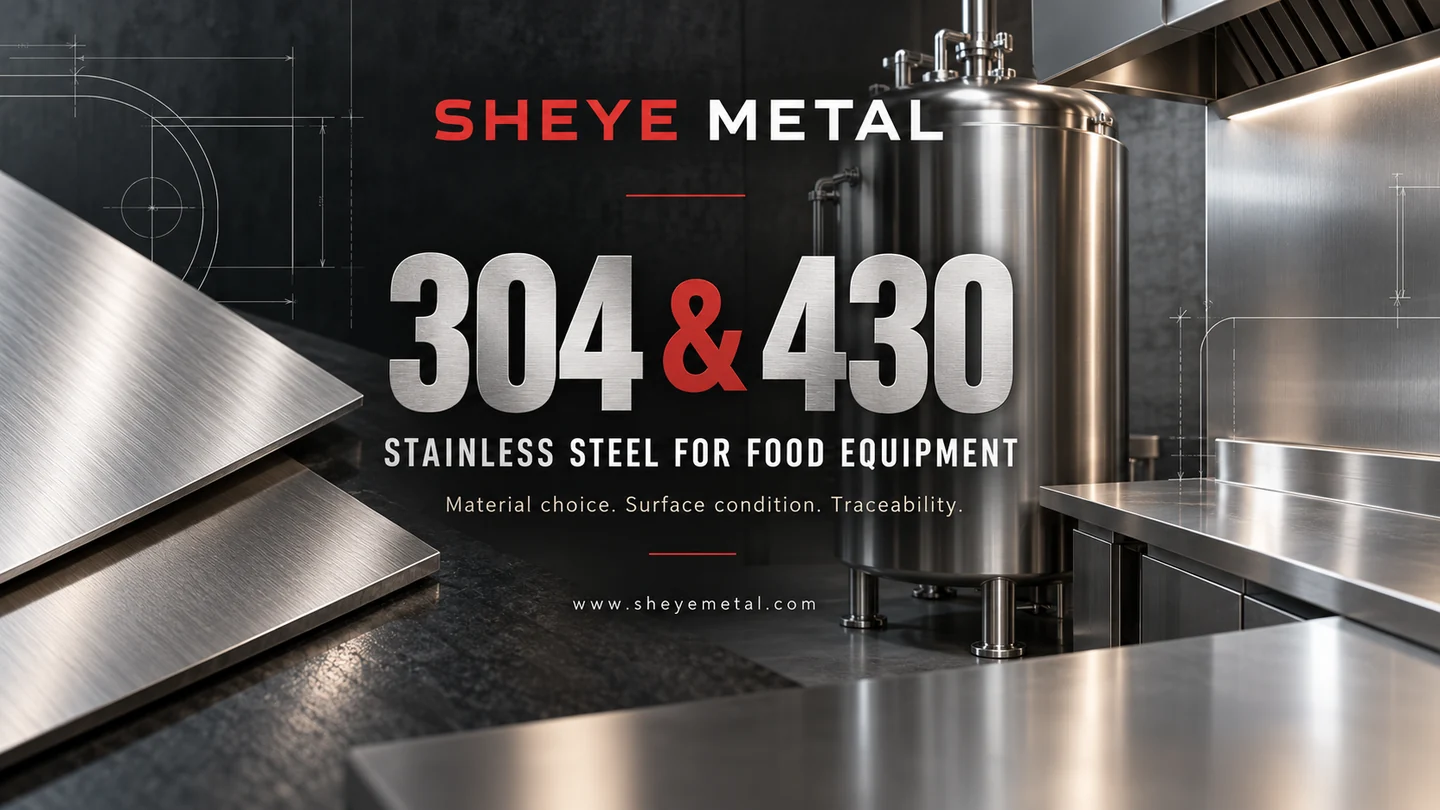
A stainless steel milk tank and a kitchen appliance panel have different jobs. The tank must accommodate its contents, welded construction and cleaning cycle. The panel may need to resist splashes, tolerate heat and keep manufacturing costs under control. These differences help explain the widespread use of both 304 and 430 stainless steel for food equipment.
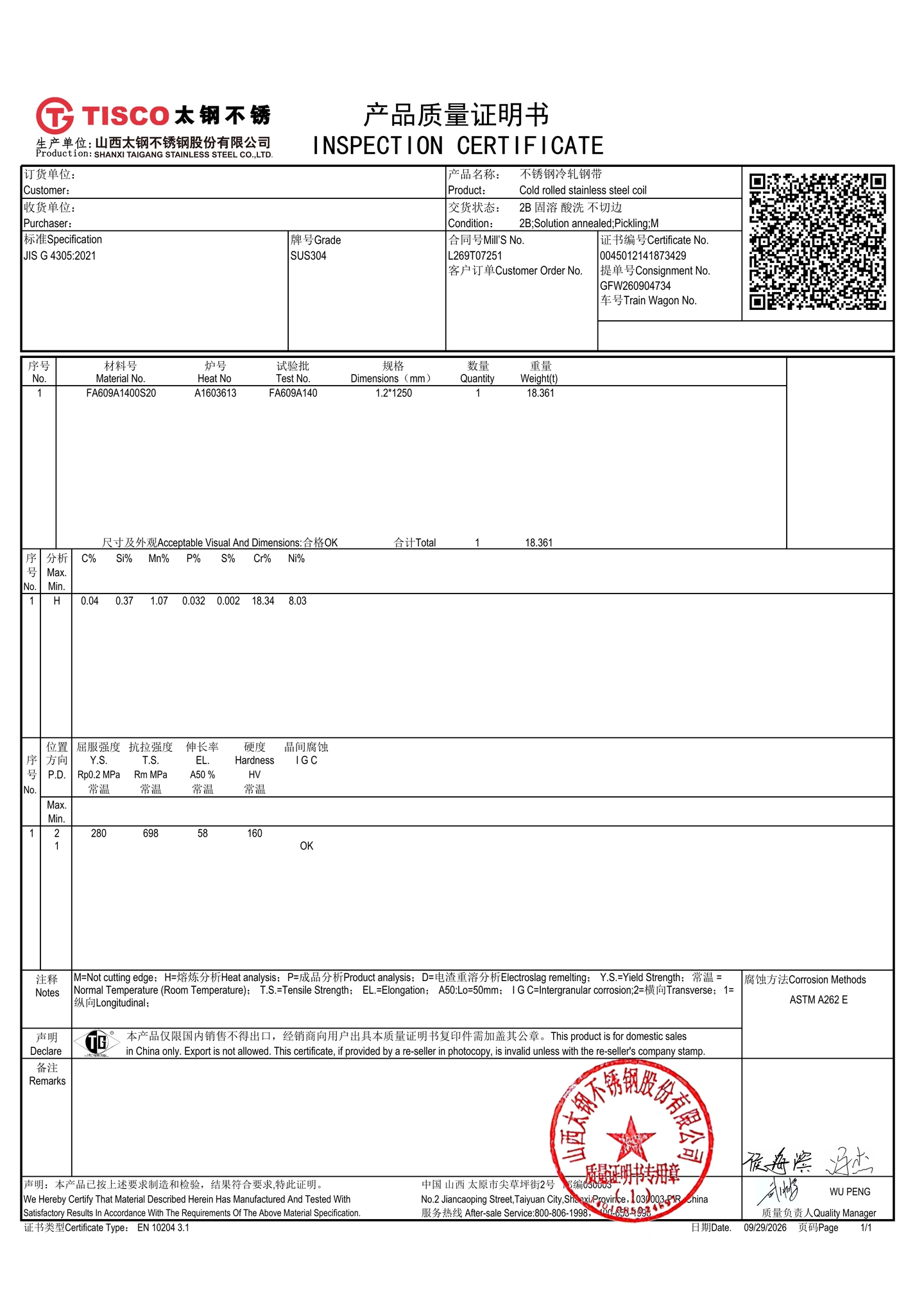
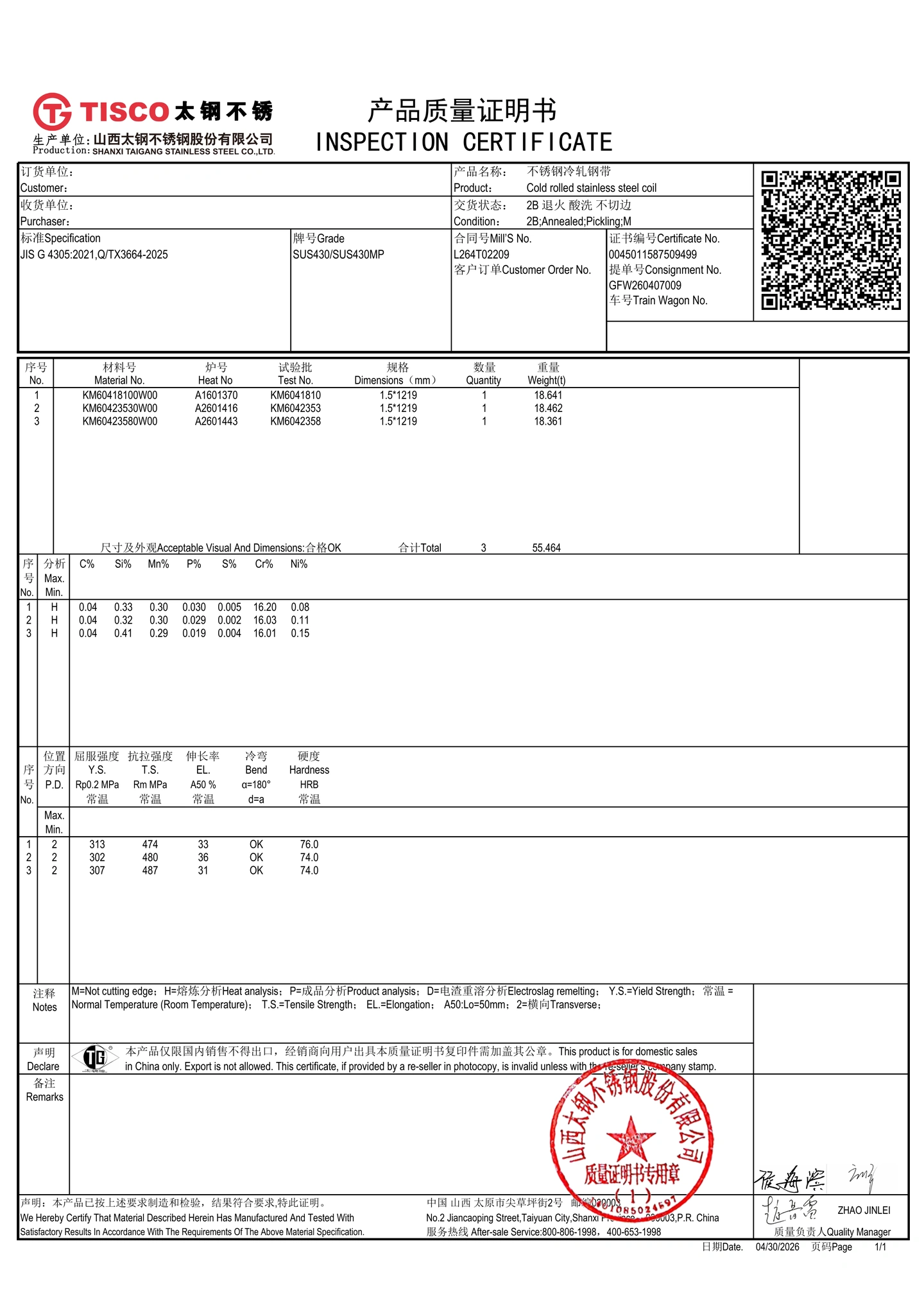
304 offers a useful combination of corrosion resistance, formability and weldability. Ferritic 430 provides an economical option for suitable kitchen surfaces and appliance components. Choosing between them starts with the part and its operating conditions. Two TISCO mill certificates supplied with this article show how actual batch records can support that decision.
What does “food-grade stainless steel” mean?
“Food-grade” describes suitability for a specified food-contact application. A grade designation alone does not establish that a finished item complies with the applicable rules. Alloy composition, fabrication, surface condition, intended contact conditions and relevant migration requirements all matter.
For products placed on the Chinese market, GB 4806.9-2023, the national food safety standard for metal materials and articles intended for food contact (Chinese text), is an important part of the assessment. It addresses material and finished-article requirements, including relevant elemental migration limits. The applicable test conditions and supporting documentation must reflect the intended use. Export buyers also need to identify the requirements of their destination market.
A mill certificate provides evidence about the steel delivered by the mill. It cannot, on its own, show how a fabricator has welded, polished, cleaned or assembled the finished product, or how that product performs in a food-contact migration test. Treat material traceability and finished-product compliance as related procurement requirements.
Why 304 stainless steel is widely used in food equipment
304 is an austenitic stainless steel commonly described as an 18% chromium, 8% nickel alloy. Chromium supports the protective passive surface film; nickel helps stabilize the austenitic structure and contributes to useful ductility and forming behaviour. This combination suits many vessels, sinks, work surfaces and welded food-processing components. BSSA’s food-industry guidance identifies 304 and 316 as widely used grades for food containers, pipework and contact equipment.
A fabricator may need to draw, bend, roll and weld the same material, then finish it to a cleanable surface. 304 is a common starting point for this work, provided that its corrosion resistance matches the product and cleaning regime.
Salt concentration, temperature, exposure time, deposits and crevices can change the corrosion risk considerably. Cleaning chemicals must be assessed by composition, concentration and temperature. A familiar grade name does not make hot chloride solutions or uncontrolled disinfectant use acceptable.
Sheye Metal’s 304 stainless steel sheet range is a starting point for discussing thickness, finish and processing requirements. The material specification should be completed with the actual service conditions and the fabricator’s acceptance criteria.
Where 430 stainless steel makes sense
430 is a chromium-based ferritic stainless steel. Its magnetic response and low nickel content distinguish it from conventional 304. It can be a practical choice for kitchen backsplashes, equipment cladding and appliance components where the corrosion and fabrication demands are suitable. Direct food contact is also possible when the finished item meets the relevant requirements for its intended use.
Ferritic grades generally have lower thermal expansion and higher thermal conductivity than comparable austenitic grades. These properties can be useful in appliance design. Grade selection still needs to account for the component’s shape, joints, temperature and environment; an appliance category alone is not a complete material specification. See worldstainless’ guide to ferritic stainless steels for the broader material context.
Lower nickel dependence can make 430 attractive when cost matters, but “nickel-free” is too absolute for a batch description. The TISCO 430 certificate below reports 0.11% nickel. Likewise, a magnet is not a food-safety test: it does not establish migration performance, surface cleanliness or compliance.
For deep forming or welded assemblies, discuss the route with the processor before substituting 430 for 304. The required forming severity and weld performance may call for a different grade or a change in fabrication practice. Sheye Metal’s 430 stainless steel sheet page provides the product context for an enquiry.
304 vs 430: compare the component, process and exposure
| Question | 304 stainless steel | 430 stainless steel |
|---|---|---|
| What is the material family? | Austenitic chromium-nickel stainless steel. | Ferritic chromium stainless steel with low nickel content. |
| Where is it commonly considered? | Vessels, sinks, work surfaces and welded food-processing equipment. | Backsplashes, cladding, housings and suitable kitchen or appliance parts. |
| What fabrication demands matter? | Often selected where forming and welding are both important. | Forming severity and welded-joint requirements need particular attention. |
| What exposure needs checking? | Food chemistry, chlorides, temperature, deposits and cleaning conditions. | The same factors, with particular care before use in persistently wet or more corrosive conditions. |
| Does the grade prove food-contact compliance? | No. Assess the finished article and intended contact conditions. | No. Appropriate direct contact is possible, subject to the same assessment. |
When should 316 enter the discussion? Its molybdenum addition improves resistance to localized corrosion in many chloride-containing environments, as explained in worldstainless’ food and beverage guide. It is worth evaluating when the conditions exceed 304’s capability. However, neither a food name such as “vinegar” nor the presence of salt automatically settles the choice. Concentration, temperature, contact duration and cleaning conditions can justify 316 or a different alloy, and should be reviewed together.
The same approach avoids blanket claims about 201 stainless steel. A product cannot be judged compliant or non-compliant from “201” alone. A proposed lower-nickel substitute needs its own corrosion, fabrication and food-contact evidence for the application; a lower purchase price does not establish equivalence to the specified 304.
Two TISCO mill certificates: what the batch data show
The following records concern 2B cold-rolled coil. They are examples of incoming material documentation, rather than tests on completed food equipment. Buyer and seller names have been removed in white from the public reference copies; the mill identity and technical records remain visible.
The 304 certificate covers one coil. The 430 certificate contains three coil entries; the comparison below uses its second row, material number KM60423530W00, which matches the selected source file. Values from that row should not be treated as measurements for every coil listed on the certificate.
| Record | 304 coil | 430 coil, second row |
|---|---|---|
| Recorded grade | SUS304 | SUS430 / SUS430MP |
| Certificate number | 0045012141873429 | 0045011587509499 |
| Certificate date | 29 September 2026 | 30 April 2026 |
| Material / heat number | FA609A1400S20 / A1603613 | KM60423530W00 / A2601416 |
| Recorded standards | JIS G4305:2021 | JIS G4305:2021; Q/TX3664-2025 |
| Nominal thickness × width | 1.2 × 1250 mm | 1.5 × 1219 mm |
| Selected coil mass | 18.361 tonnes | 18.462 tonnes |
| Finish and condition | 2B; solution annealed, pickled, mill edge | 2B; annealed, pickled, mill edge |
| Property | SUS304 | SUS430 / SUS430MP |
|---|---|---|
| Carbon, % | 0.04 | 0.04 |
| Chromium, % | 18.34 | 16.03 |
| Nickel, % | 8.03 | 0.11 |
| 0.2% proof strength, MPa | 280 | 302 |
| Tensile strength, MPa | 698 | 480 |
| Elongation A50, % | 58 | 36 |
| Hardness, recorded scale | 160 HV | 74 HRB |
These are recorded results for the selected coils, not grade-wide guaranteed values. The tensile results are transverse, at room temperature; A50 uses a 50 mm original gauge length. Hardness uses different scales and should not be compared as plain numbers. The 304 document identifies an EN 10204 type 3.1 inspection certificate; the 430 page does not state that certificate type. Neither document contains a food-contact migration report or a GB 4806.9 compliance declaration.
This 304 heat contains substantially more nickel than the selected 430 heat. Their tensile results also differ, so a fabricator reviewing these records should check them against the intended forming operation. Two coils of different grades and thicknesses cannot establish a universal ranking of finished-part performance.
Surface condition and fabrication complete the specification
A correctly identified alloy can still leave the workshop with difficult-to-clean welds, embedded iron contamination, polishing residue or crevices. These details affect service performance and should be addressed before the equipment is accepted.
A 2B mill finish is a starting surface condition. Further forming, welding and finishing may change it. Where the application requires a defined surface roughness, specify the value and measurement method rather than relying on “bright,” “smooth” or a finish name alone. Weld finishing and any cleaning, pickling or passivation treatment should be appropriate to the fabrication and followed by effective residue removal.
For a procurement specification, record:
- Contact and cleaning conditions: food or process medium, concentration, temperature, contact time and cleaning chemicals.
- Material and fabrication: grade, product standard, thickness tolerance, forming route, weld requirements and traceability.
- Finished surface: accessible, cleanable geometry; agreed weld quality and roughness where relevant; removal of contamination and processing residues.
- Evidence for acceptance: mill certificates, processing records and the applicable finished-article food-contact documentation or test reports.
Specify the job before choosing the grade
304 and 430 remain useful because they cover different combinations of exposure, fabrication and cost. 304 is a common candidate for formed and welded food-contact equipment. 430 can be a sensible choice for suitable kitchen surfaces and appliance components, including direct-contact parts where the conditions and compliance evidence support it.
When requesting a quotation from Sheye Metal, send the intended use, destination market, grade, thickness, dimensions, finish and processing requirements. Include the relevant cleaning conditions and any required food-contact documentation. Our quality information and the batch certificates can support the material review; the finished equipment still needs assessment against its own specification.
Contact Sheye Metal about 304 or 430 stainless steel for your food-equipment project.
PRODUCTS
Related products
304 Stainless Steel Sheet
304 stainless steel sheet supply with cut-to-length, flatness and protection requirements reviewed for your order.
View specifications430 Stainless Steel Sheet
430 stainless steel sheet supply with cut-to-length, flatness and protection requirements reviewed for your order.
View specifications